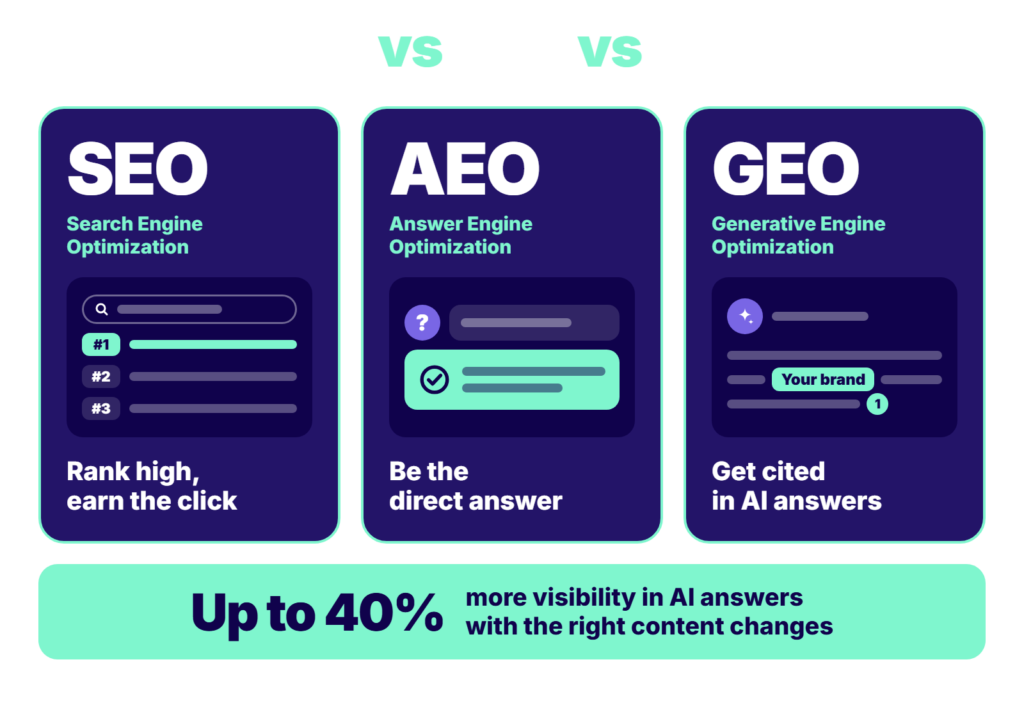
Traditional SEO helps your pages rank in search results. AEO helps you appear for direct answers in search engines and AI bots. GEO helps AI systems cite your content when they generate answers.
The difference is subtle, especially when it comes to optimizing your content so that it ranks everywhere.
They’re different sides of the same coin. The goal is the same: Getting yourself found. This guide gets into the details of all three, where they overlap, and where you should put your effort.
What Is SEO?
Search engine optimization aims to make your website rank higher in search engines like Google. Your site’s technical health, content quality, keywords, and links from other websites are all parts of the broader SEO concept.
The goal is simple: You want your web pages to appear at the top of page one when someone searches for something around what you offer. The next goal is earning the click and converting that traffic into conversions.
What Is AEO?
Answer engine optimization focuses more on getting your content chosen as the direct answer to a question.
It means writing concise and clear answers to specific questions and structuring your content for AI platforms to easily pick your answers.
What Is GEO?
Generative engine optimisation is when you write and structure your content so that it gets picked up by AI tools like ChatGPT, Perplexity, Gemini, and Google’s AI Overviews.
Research shows that the right changes in your content can improve its visibility in AI-generated answers by up to 40%. With GEO, the goal is to get your brand mentioned or your content cited inside AI answers. Whether you get a click or not is a different story.
What’s the Difference Between GEO, SEO, and AEO?
Let’s understand the difference between all three by looking at what each one tries to achieve.
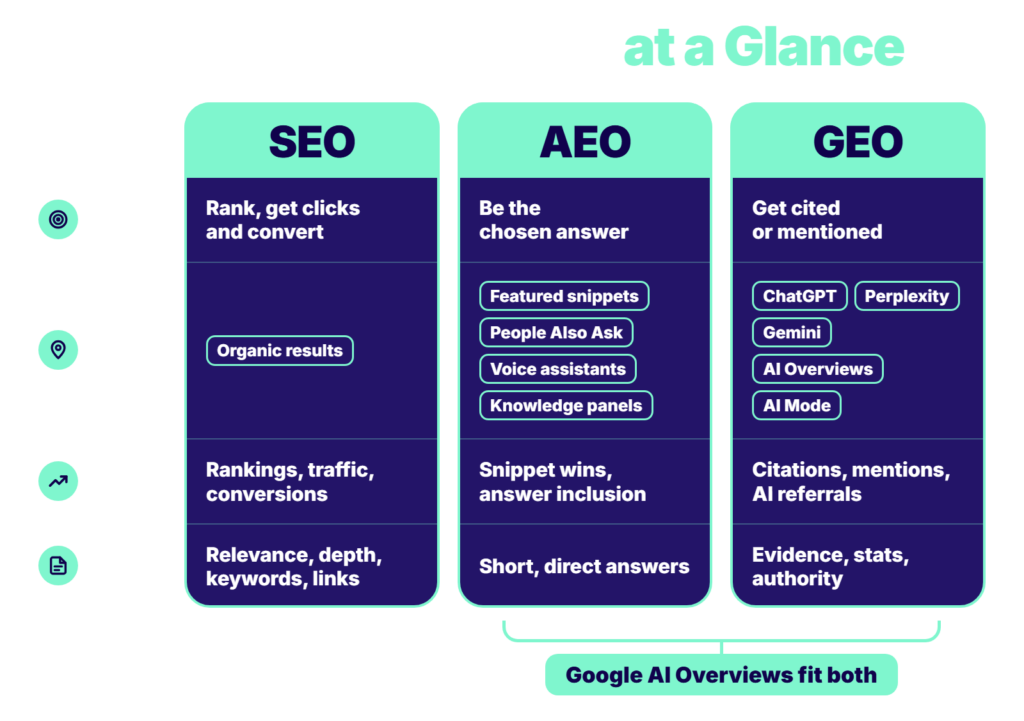
| SEO | AEO | GEO | |
|---|---|---|---|
| Main goal | Rank, get clicks, and convert traffic | Get picked up in AI answers | Get cited or mentioned in AI results |
| Where you appear | Organic search results | Featured snippets, People Also Ask, voice assistants, knowledge panels | ChatGPT, Perplexity, Gemini, Google AI Overviews and AI Mode |
| What success looks like | Rankings, traffic, conversions | Snippet wins, answer inclusion | Citations, brand mentions, AI referral traffic |
| Content focus | Relevance, depth, keywords, links | Short, direct answers to clear questions | Evidence, sources, statistics, brand authority |
Notice that the lines blur in some places. For instance, Google’s AI Overviews fit both in AEO and GEO. Both involve offering direct answers so that AI models can pick them up.
Is Traditional SEO vs AI SEO Really an Either-Or Choice?
Not according to the people whose opinions matter in this field. Google’s Danny Sullivan said, “Good SEO is good SEO.” He said the same goes for AEO and the other new acronyms, and that the core work remains creating unique, valuable content for people and offering a great page experience.
Lily Ray takes a similar line. In a talk, she explains that the new acronyms largely describe the same work, and that the AI visibility strategies grow out of existing SEO best practices. The difference is in measurement. This means you may need to use different KPIs and strategies to track your progress in AI results.
The data backs up a related view; Ahrefs, for instance, found that only 38% of pages cited in AI Overviews also ranked in the top 10 for the same query. SEO rankings can help, but they don’t guarantee AI Citations. On the flip side, a page outside the top 10 can get pulled in by AI engines. We go into more detail on that in our post on how to appear in Google AI Overviews.
Why Does AI Search Deserve Your Attention?
Mainly because traffic from AI search often behaves differently. Semrush found that the average AI search visitor is worth 4.4 times as much as a traditional organic visitor, based on conversion rates. Also, it points out that AI channels could drive similar economic value to traditional search by the end of 2027.
The reason AI traffic may have a higher value is that people often get enough information before they make the decision to visit a website. On the other hand, they don’t know much about what’s on a website before they click on it from traditional organic results. This means when someone clicks through from an AI answer, they might be closer to buying.
The important thing to note here is that AI referral traffic might still be a small slice of the total for many websites. But if those visitors convert better, even small growth can make a difference to your revenue.
Which One Should Your Business Focus on First?
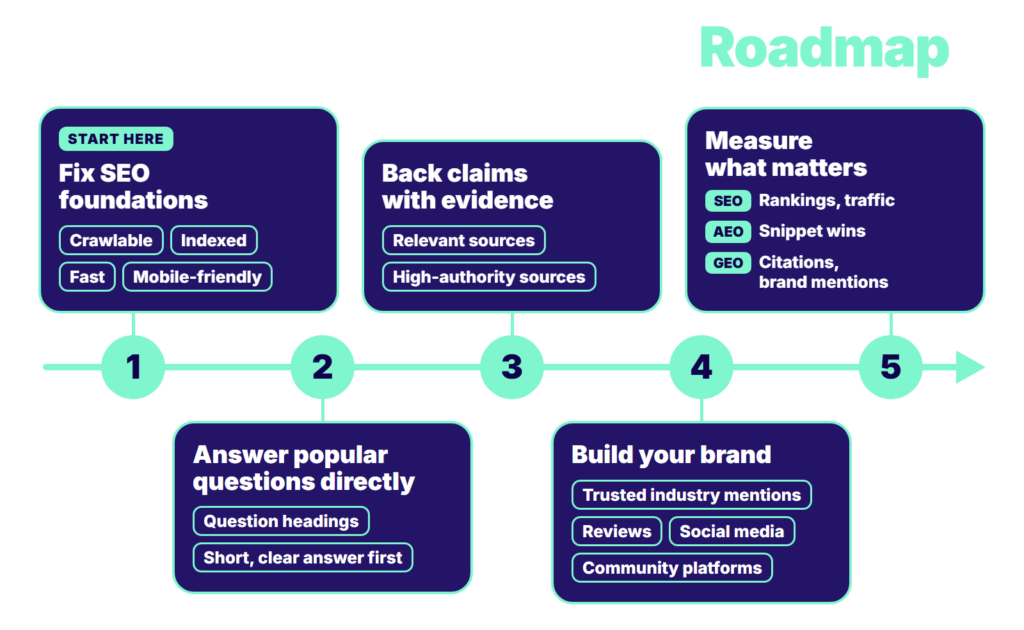
Starting with the core SEO principles lets you build solid foundations. Once you have the pillar of SEO in place, build AEO and GEO on top of it. Here’s a practical order:
Fix Your SEO Foundations: Your pages must be crawlable, indexed, fast, and mobile-friendly. Remember that AI tools often use traditional search results to fetch their information, which means weak SEO can hold you back.
Try to Answer Popular Questions Directly: Use question-style headings. Write a short, clear answer at the beginning of each answer.
Use Evidence to Back Up Your Claims: Relevant, high-authority sources add weight to your claims. They give AI systems a solid reason to cite your content.
Build Your Brand: Don’t stop at building a strong website. Build your brand through mentions on trusted industry sites, reviews, social media, and community platforms. A well-rounded presence can shape what AI tools say about you.
Measure What Matters: As mentioned earlier, the KPIs you should be tracking have evolved. Track your rankings and traffic for SEO, snippet wins for AEO, and citations and brand mentions for GEO.
How Can AI SEO Help You With SEO, AEO and GEO?
You can learn and try to implement all three strategies on your own, but that will consume your time. The time you’re better off giving to serving your customers. Plus, SEO, AEO, and GEO are all evolving and have multiple moving parts. You’re better off hiring experts. At AI SEO, we work across all of them, from technical SEO and content to answer engine optimization and AI citations, so your business stays visible.