Search behavior has changed a lot in the past few years. Google and other search engines don’t show 10 blue links against a searched keyword anymore.
Users get a range of results; it can be a featured snippet with a direct answer, an AI Overview with sections that often cover the query comprehensively, eliminating the need for users to visit websites.
Here’s the problem: If you’re not optimizing your website’s content for this evolving search behavior, you’re leaving visibility on the table.
Now, that’s the exact problem Generative Engine Optimization (GEO) takes care of. If you have an online audience and you want people to find you from search engines, GEO isn’t optional for you anymore.
What Does GEO Actually Mean?
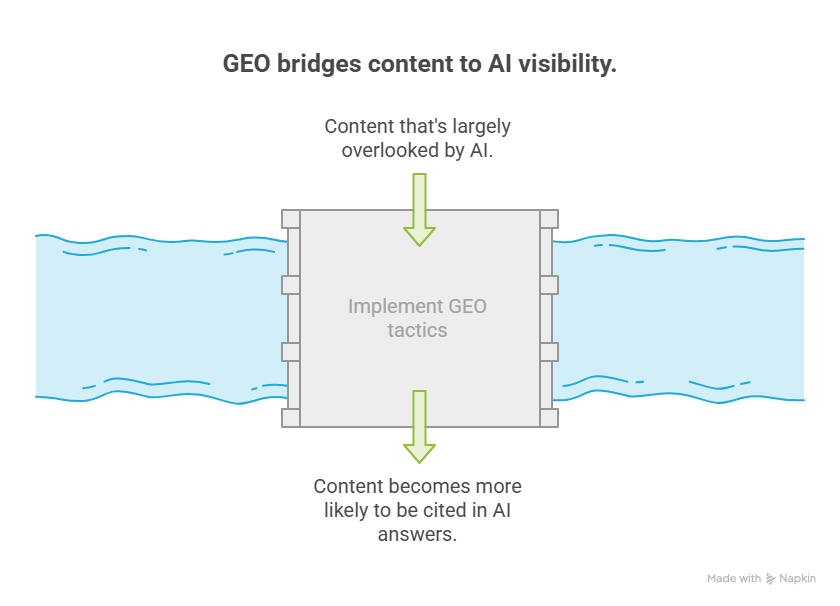
Let’s see how it works. GEO is when you optimize your content so that AI-powered search engines can find it, understand it, and share it in their answers.
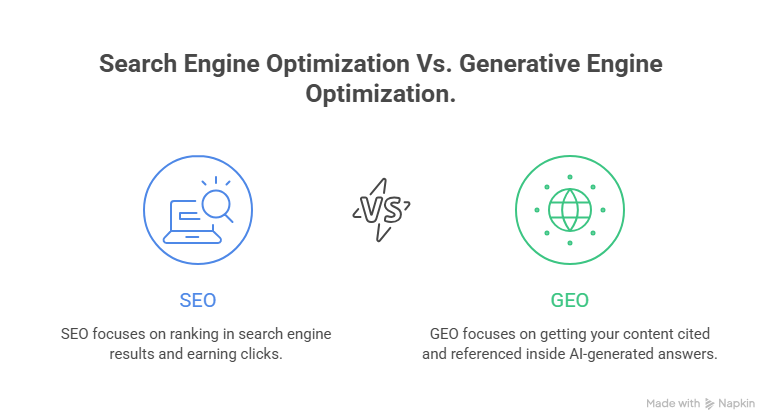
Traditional SEO is purely focused on getting your pages ranked among the top 10; GEO is a slightly modified form of that, helping you get cited in AI answers.
The term was probably introduced by a research team from Princeton University and the Allen Institute for AI in a paper published in a reputable academic conference.
It found that implementing GEO can boost visibility by 40% in generative engine responses, which is a significant improvement.
Today, GEO has become an important part of how smart businesses approach content creation for AI-enabled search engines.
Why Should You Care About GEO Right Now?
The simple reason to take SEO seriously is that its importance is backed by real numbers and data, not conjecture or theories.
You’ve probably used ChatGPT already; it alone has over 1 billion monthly active users as of mid-2026. You can’t ignore that kind of user base as a business owner.
Another popular AI platform, Perplexity, gets around 780 million searches per month. And of course, Google’s own AI Overviews sit right at the top for many search queries, and given the size of Google’s user base, you can imagine how many people are exposed to AI answers.
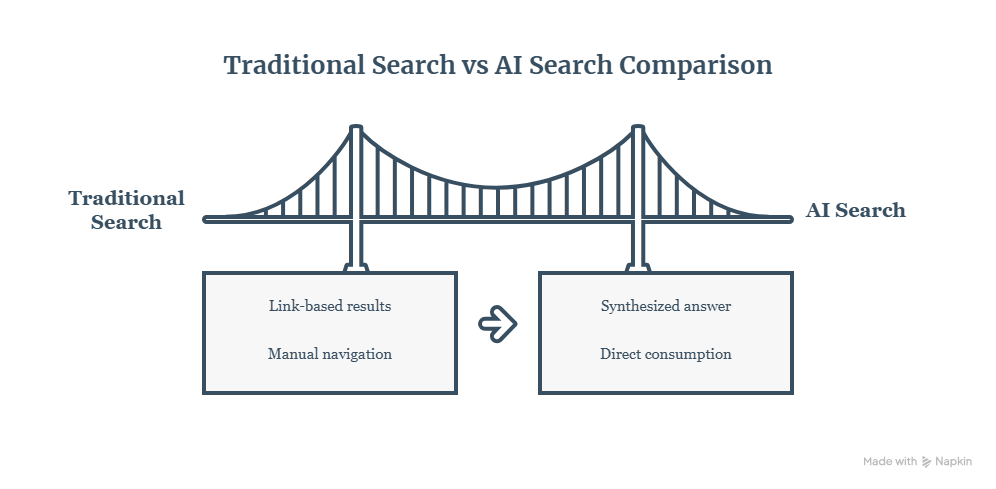
Understand that these platforms don’t send people to sites the way traditional search results did (Or do). They “Synthesize” an answer based on what’s available on different sources online for that particular query.
Users usually get a concise yet comprehensive answer to their queries with links pointing to the most relevant sources.
At the same time, search traffic for traditional results is shrinking. According to iO, organic search traffic could drop by 50% or more by 2028 as many people also use AI-powered search tools.
And if an AI Overview or answer offers everything a searcher wants, there’s seldom a need to click a link or land on any website.
Importantly, this isn’t some future prediction; it has started to happen at a scale many of us might not have expected in the recent past.
SparkToro’s recent study found that around 68% of US Google searches now end without a single click to a website.
On the flip side, “AI-recommended traffic to US retail sites grew a whopping 393% year over year in Q1 of 2026. The even more impressive stat? That traffic converts about 42% better than non-AI traffic.
Here’s what that means: The opportunity isn’t vanishing; it’s moving to a different place, and GEO helps you stay visible there.
How Is GEO Different from Traditional SEO?
I think SEO is an umbrella term; it helps you get visibility in all types of search engines. But ever since AI came to the limelight, GEO has become an integral part of it, but it’s not an entirely separate thing.
In a traditional sense of the word, SEO mainly competes for clicks, whereas generative engine optimization’s goal is to win citations and AI mentions.
When you implement SEO, your goal is to rank in one of the top 10 positions on Google against a particular keyword. And you earn a click when someone finds your result to be worthy of a visit.
With GEO, you’re more intentional in optimizing your content for AI engines: How they pull information from your content when generating an answer.
Essentially, your content becomes an important source behind the AI response.
Now, it’s easy to confuse the two terms. As I mentioned before, GEO isn’t something entirely different from SEO. Actually, it builds on top of it.
For instance, if you carefully look at the search results and AI citations, you’ll notice that, more often than not, the same results appear in both.
This is because content that ranks well in traditional search tends to perform well in AI results as well. The key is to understand and implement the core concepts of search engine optimization and adapt your content for AI tools.
E-E-A-T (Experience, Expertise, Authoritativeness, Trustworthiness) matters a lot no matter where you’re trying to rank your business.
The main difference is how you structure and present a piece of content.
What Tactics Actually Improve Your GEO Visibility?
Here are the strategies that can show measurable results:
Citing credible sources can deliver the strongest gains. For content with a low domain authority behind it, adding proper citations can improve visibility. AI platforms are more likely to trust and reference pieces of content that are well-cited.
Using statistics and studies can improve visibility. Specific numbers give search and AI bots something concrete to use in their responses.
Including expert quotations is another way to improve your content’s visibility. Attributed quotes signal authority and provide quotable material to AI.
But here’s what isn’t likely to work anymore: Keyword stuffing. On the contrary, using keywords unnaturally can work against you, i.e., decrease visibility. And generic, surface-level content doesn’t usually perform well.
How Can AISEO Help?
If you have an audience searching for businesses like yours, you need a comprehensive strategy that includes SEO and GEO.
AISEO helps your online visibility by optimizing both traditional and AI-powered search. From technical SEO foundations to GEO-specific strategies, we handle every important layer of modern searh.