Google, AI assistants, and other search engines look at the intent behind search queries, not just the words on a page. They work out what those searches refer to: A company, a person, a place, or a product. It’s this shift that makes entity SEO so important these days.
When ChatGPT, Gemini, or even Google’s AI Overviews describe a business, they pull information from online sources with real facts and connections. If that picture is unclear, it may lead to your brand being pushed down or left out of the answer.
In this guide, you’ll learn what an entity is, how it works, how AI systems understand brands, and some practical steps to make your brand easier to recognise and cite in search.
What Is an Entity in SEO?
An entity is a distinct thing that a search engine can identify and describe, such as a person, organisation, place, idea, or product. Google describes it as “A person, place, or thing“.
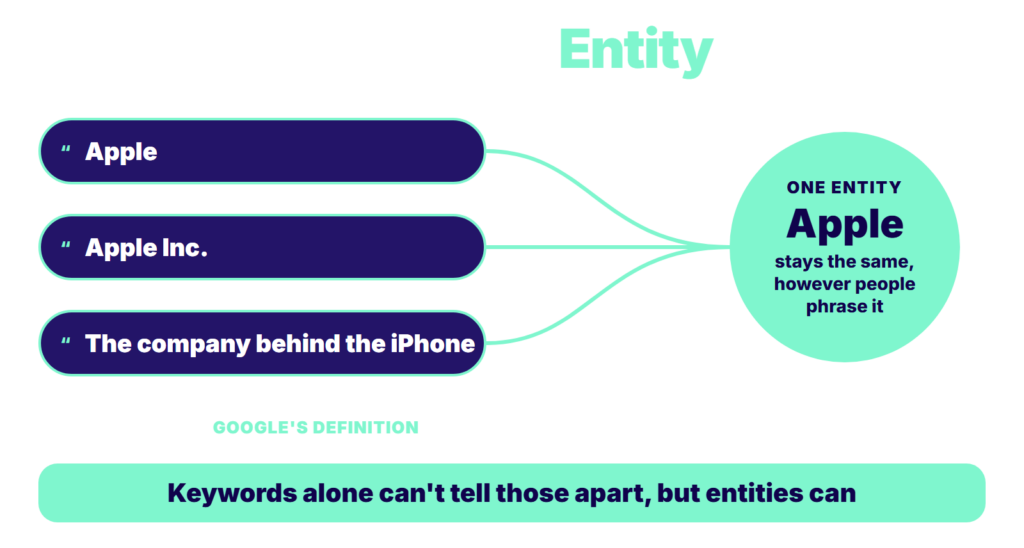
It says the same, no matter how people phrase it. For instance, “Apple”, “Apple Inc.” and “The company behind the iPhone” all point to one entity.
An entity stays the same, no matter how people phrase it. “Apple”, “Apple Inc.” and “the company behind the iPhone” all point to one entity. Keywords alone can’t tell those apart, but entities can.
What Is Entity SEO?
It’s when you make your brand, people, products, and topics clear, consistent, and well connected, so search engines and AI systems can recognise them and trust what they know about them.
In keyword SEO, the focus is on which keywords the page should rank for, while in Entity SEO, the question is whether Google knows who you are, what you do, and how you connect to other things. However, both concepts work together; you still need a solid keyword strategy; entity SEO builds on top of that.
You might also hear people call it entity optimisation, semantic SEO, or knowledge graph SEO. The terms often overlap.
What Is the Knowledge Graph?
Google’s Knowledge Graph is a collection of facts about entities and the relationships between them.
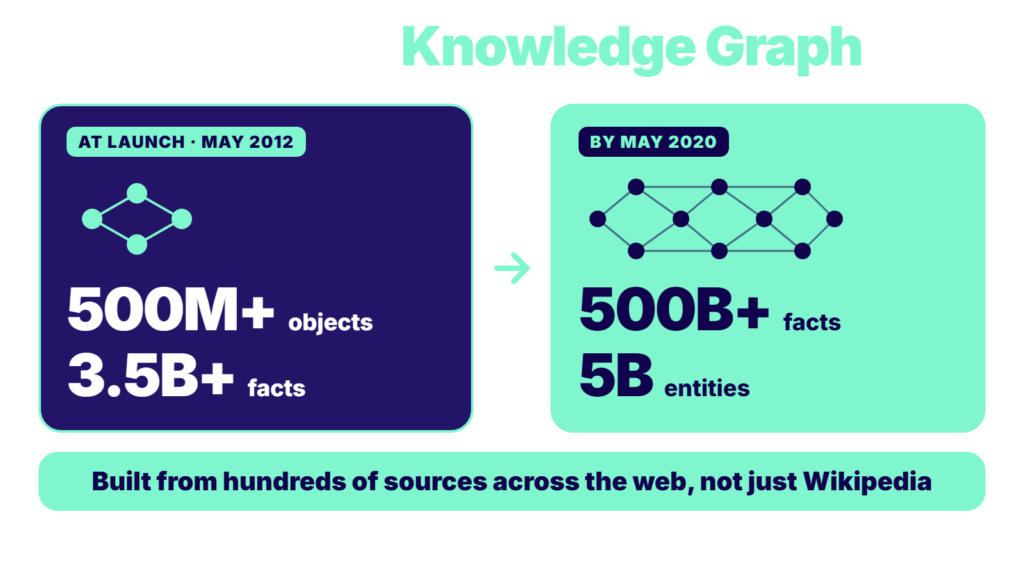
When it launched in May 2012, the Knowledge Graph held more than 500 million objects and over 3.5 billion facts about them and the relationships between them. By May 2020, Google’s Danny Sullivan wrote that it had grown to over 500 billion facts about five billion entities. That figure is now several years old, so the graph has likely grown since.
Wikipedia is a commonly cited source in Knowledge Graphs, but it’s not the only one. It uses hundreds of sources across the web. This means your website is part of the picture, and what other sources say about you affects how Google describes you.
How Does AI Understand Brands?
AI platforms use structured facts, such as text they learned from during training and the web pages they find when answering a question, to build their picture of a brand. Generally, the clearer and more consistent your brand looks across the internet, the easier it is for AI to describe you accurately.
Here’s some evidence that entity signals feed AI search:
- Google AI Mode can tap into fresh, real-time sources like the Knowledge Graph, according to Google’s Match 2025 announcement.
- Schema markup helps AI understand your brand as well as confirmed by Microsoft.
- Ahrefs studied 75,000 brands and found that branded web mentions had the strongest correlation with brand visibility in AI Overviews.
Note that correlation doesn’t equal causation, and the Ahrefs study only looked at Google’s AI Overviews. Still, the pattern suggests AI systems pay close attention to how widely and consistently people discuss a brand across the web, beyond what the brand says about itself.
If you want to show up in those answers, our guide on how to appear in Google AI Overviews covers the wider picture.
How Do You Optimise Your Brand as an Entity?
Start by stating clear facts about your brand on your own website. Mark those facts up with structured data, and keep them consistent everywhere. Try to earn independent mentions that confirm those facts.
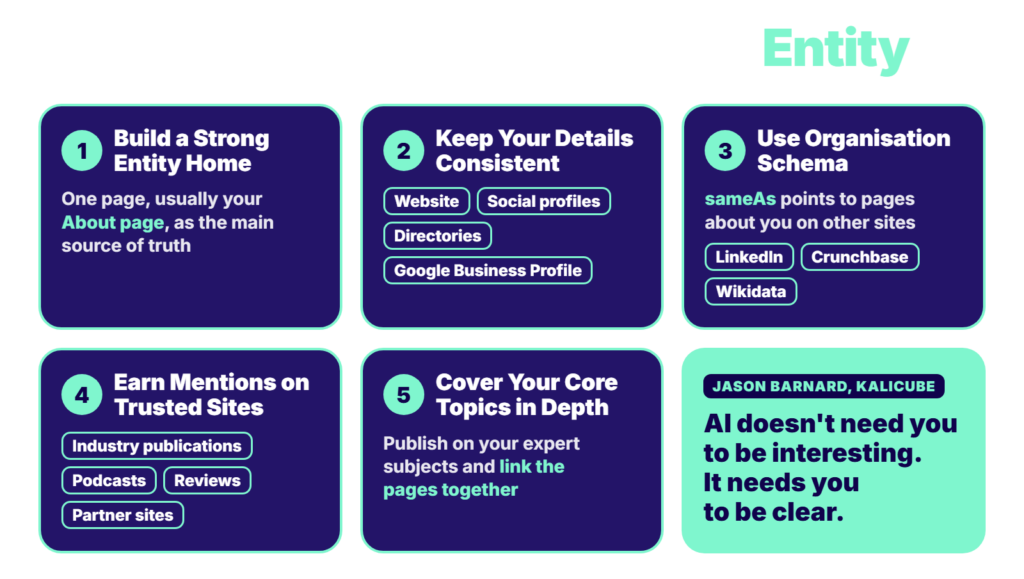
- Build a strong Entity Home: Choose one page, usually your About Page, as the main source of truth about your brand. Jason Barnard, founder of Kalicube, calls this your Entity Home and recommends a Claim, Frame, Prove approach. He says that AI doesn’t need you to be interesting; it needs you to be clear.
- Keep your details consistent: Use the same core details on your website, social profiles, directories, and Google Business Profile. Even small differences can make it harder for systems to match records to one brand.
- Use organisation schema: Organisation structured data can help Google understand your organisation’s administrative details and tell you apart from other organisations. The sameAs property points to pages about you on other websites, such as LinkedIn, Crunchbase, or Wikidata.
- Earn mentions on trusted sites: Try to get mentions on industry publications, podcasts, reviews, and partner sites; they act as independent proof of your claims.
- Cover your core topics in depth: Publish content on the subjects you want to be known as an expert on, and link those pages together naturally.
How Can You Check If Google Sees Your Brand as an Entity?
Check if your brand has a knowledge panel. You can also test how AI tools describe you manually.
Search your brand name: A knowledge panel on the right of the results or near the top on mobile suggests Google recognises your brand as an entity.
Try the Knowledge Graph Search API: Use Google’s Knowledge Graph Search API as a quick check; it can help you find entities in Google’s Knowledge Graph.
Ask AI tools about your brand: Prompt ChatGPT, Gemini, and Perplexity with a question like “What is (your brand name)?” Note any wrong or missing facts. Our guide on ranking in ChatGPT covers this topic in more depth.
How Can AI SEO Help With Entity Optimisation?
Entity optimisation is an important part of our AI SEO services. We help you strengthen your brand’s entity signals through structured content, semantic relationships, and consistent business information that AI models can easily understand. If you’d like to find out how clearly AI understands your brand today, get in touch with our team.