No, Google doesn’t penalise content just because AI helped you create it. It judges content based on quality, not on how it was created. However, low-quality pages, whether they’re made with AI or by a human, and intended to trick search rankings, can break Google’s spam policies. Eventually, even if your content ranks for a while, Google will push it down, or worse, remove it from its search engine. Therefore, the real question isn’t whether you use AI; it’s whether your content is accurate, original, and helpful.
This guide covers what you need to know about AI content and Google’s guidelines, whether Google can accurately detect AI content, and how you can use AI the right way.
What Is AI-Generated Content?
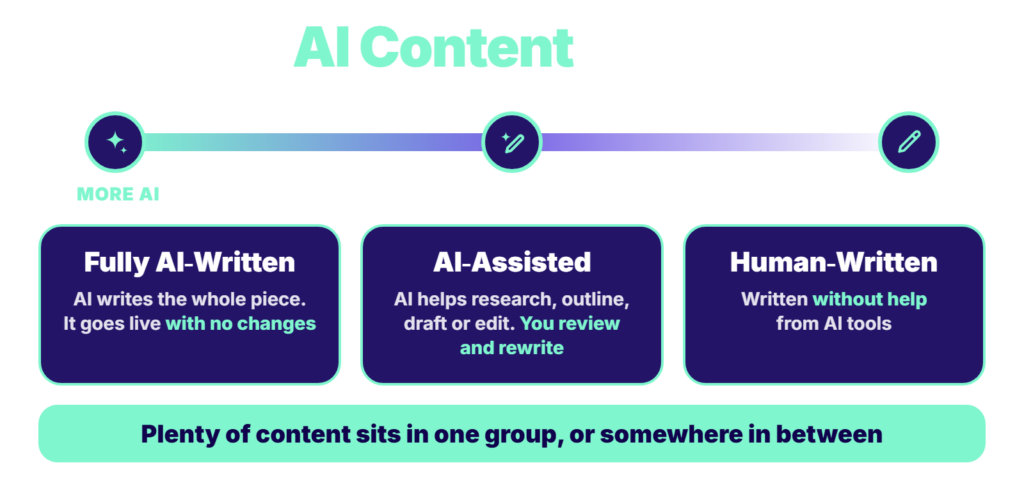
AI-generated content is any kind of material, including text, image, and video created fully or partly by an AI tool like Gemini, ChatGPT, or Claude. AI content tends to sit on a scale from a practical standpoint.
- Fully AI-Written: An AI tool writes the whole piece, and it goes live without you making any changes to it.
- AI-Assisted: You use AI to research, outline, draft, or edit, then review and rewrite the final piece.
- Human-Written: Everything you write is without the assistance of an AI tool.
Plenty of content these days falls under one of those categories, or in the middle somewhere.
What Does Google Say About AI Content?
The company has been clear on this since 2023. It focuses on rewarding high-quality content, no matter how it’s produced. The current guidelines by Google go further; they say generative AI can be useful when researching a topic and for adding structure to original content. However, note that generative models can’t accurately retrieve facts every time, so you need to check what AI tools produce for accuracy before you publish.
Does Google Penalise AI-Generated Content?
It doesn’t, not for using AI, at least. Google doesn’t penalise using a tool; it penalises a specific type of behaviour, whoever, or whatever does it. Google’s spam policies describe scaled content abuse as creating many pages “For the primary purpose of manipulating search rankings.” Therefore, if you’re creating multiple pages with AI content without making them valuable for users, or making them helpful, your content falls under that category.
The key phrase there is “No matter how it’s created.” Google applies the same rules to bulk, low-value content whether a person wrote it, a machine created it, or both were involved. Why do AI tools often get caught up in the conversation? Because they simply make the process of “scaled content” without adding value much easier.
Is AI Content Bad for SEO?
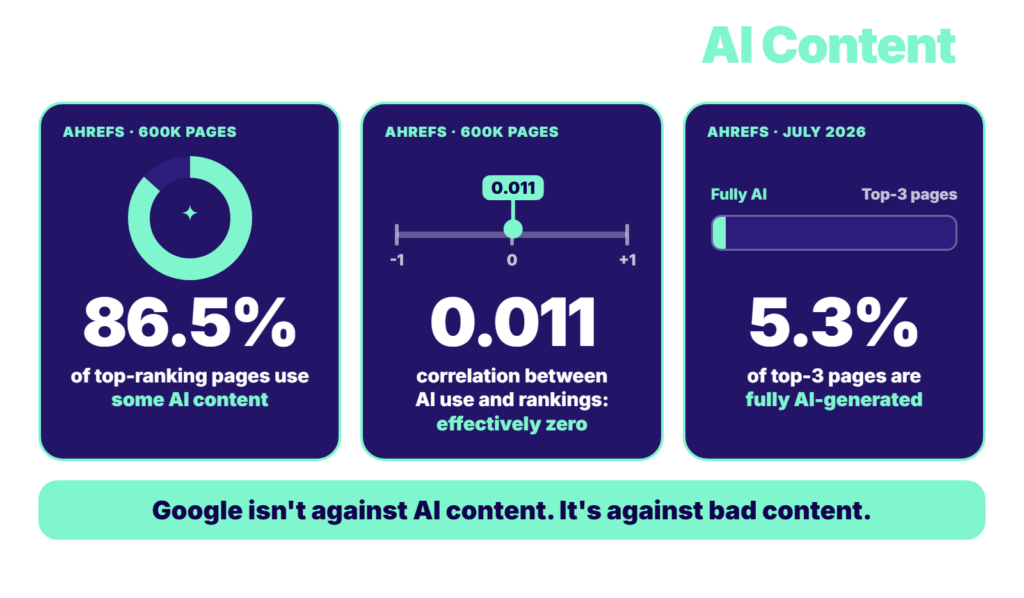
AI content isn’t bad for SEO by default, but low-quality content is. The data seems to support that. An Ahrefs study of 600k pages, for instance, found that more than 85% of top-ranking pages contained some AI-generated content. Only under 14% were purely human-written, and around 4.5% were purely AI. Therefore, the correlation between how much AI a page used and how well it ranked is almost zero.
Purely AI content can also rank; according to Ahrefs’ study published in July 2026 found that 5.3% of pages in the top three positions were fully AI-generated. However, heavily AI-written pages are less likely to be indexed. So, Google isn’t against AI content; it’s against bad content.
Can Google Detect AI Content?
Google doesn’t use AI detection to qualify and rank pages on its search engine. It judges your content on quality and helpfulness, whether AI was involved or not.
What we do know is that detecting AI content isn’t easy. In fact, OpenAI, the company behind ChatGPT, shut down its own AI text classifier in 2023 because of its “Low rate of accuracy.” Third-party tools can even flag fully human-written content as AI, and miss AI writing.
Google hasn’t said publicly that it uses AI detection to rank pages. Its public position is that it judges content on quality and helpfulness, whether AI was involved or not. Therefore, trying to trick an AI detector shouldn’t be the goal. If a page is thin, inaccurate, or copies what’s already out there, it can struggle in search whether an AI detector flags it or not. If it’s useful, the tool you use to write it matters far less.
What Can Get AI Content Into Trouble?
AI content can get you into trouble in a few scenarios:
Publishing at Scale Without Review: Creating tens of pages quickly, with no human check, is what the scaled content policy prohibits.
Factual Errors: AI tools can be inaccurate at retrieving factual information. They can hallucinate with confidence. Publishing AI-written facts without verifying them yourself can damage trust with search engines and readers.
Unoriginal Content: Rewording what’s already out there adds little to your piece. It’s not fully original. There’s little reason for Google to show your page instead of the original.
No Real Experience: Content with first-hand insight or experience has a better chance on search results. This is especially important for topics like health and finance.
Marie Haynes makes a strong supporting point regarding this. She suggests asking yourself whether the page adds to the body of information on a topic, or is it a simple rewrite of what others already say.
How Can You Use AI Safely for SEO Content?
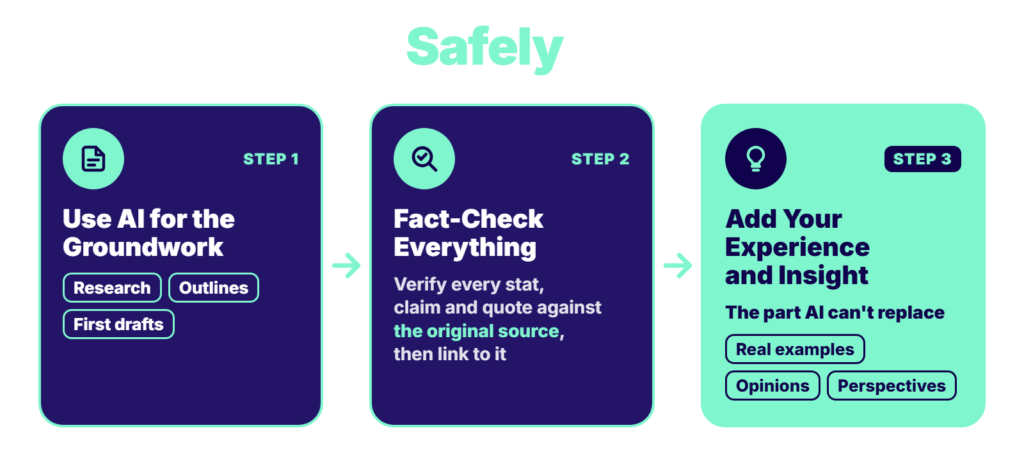
Here’s how you can craft Google-friendly content while using AI:
Use AI for the Groundwork: Artificial intelligence can save you a lot of time with research, outlines, and first drafts.
Fact-Check Everything: Verify every statistic, claim, and quote against the original source. Link out to those sources so Google knows where the information came from.
Add Your Experience and Insight: The one thing AI can’t replace in your content is your personal experiences and insight. Real examples, opinions, and perspectives can make your content stand out and be worth reading.
How Can AI SEO Help With Your Content?
AI can help speed up content creation, but it’s the quality, accuracy, and expertise that actually rank your pages on Google. AI SEO helps businesses create Google-friendly content so you don’t have to worry about all that.