LLM optimisation involves making your content and brand easy for large language models (LLMs) to understand and mention in their answers. Tools like ChatGPT, Gemini, Perplexity, Claude, and Google’s AI Overviews use these models.
LLM SEO and LLMO are a couple of popular acronyms you might encounter that essentially mean the same thing described above. However, the goal matters more than these names. When someone asks an AI tool something related to your industry, you want your business (or content on your site) to be part of the answer.
This guide explains what LLM optimisation is, how LLM tools pick their sources, and what you can do today to improve your chances of getting cited or recommended.
What Does LLM Optimisation Mean in Simple Terms?
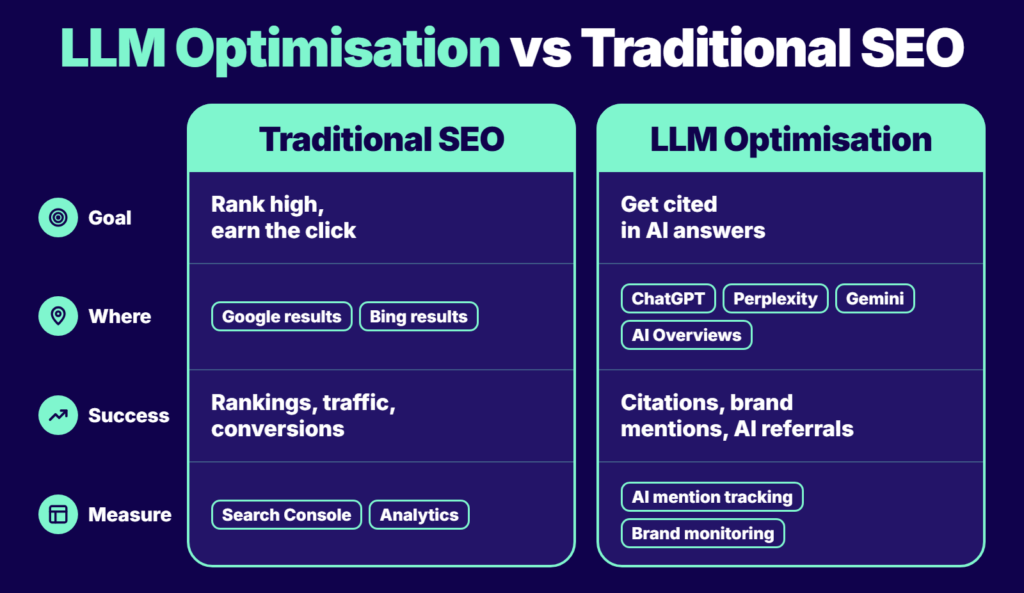
Think of large language models as the technology behind AI chatbots. They learn from a large chunk of data and use that to create answers in their responses. Traditional SEO efforts usually focus on ranking a page or a link in the top 10 search results against a particular search query. LLM optimisation focuses on making your content friendly towards AI systems, improving your chances of recommendations, citations, or mentions by AI.
Neil Patel breaks down LLM optimisation into three categories:
- Create authoritative content
- Structure your content so AI can understand it
- Track your brand’s presence in AI responses
Is LLM Optimisation the Same as LLM SEO, GEO or AEO?
These terms do overlap a lot, and you might notice people using them to describe the same work. LLM optimisation and LLM SEO both allude to AI models. Generative engine optimisation (GEO) is more about AI systems that write answers from multiple sources.
Answer engine optimisation (AEO), as the name suggests, focuses mostly on providing direct answers, so you get visibility in featured snippets and voice assistants. You can learn more about these acronyms and how they overlap with each other in our post GEO vs SEO vs AEO.
Why Does LLM Optimisation Matter for Your Business?
Because many of your potential customers might be using AI tools to find answers to their questions. Plus, Google also shows an AI-powered overview that provides a comprehensive answer to many queries.
OpenAI reported 900 million weekly active users of ChatGPT in early 2026. Many of those searches might be around product advice and brand recommendations. And it’s worth noting that people who click on links AI tools recommend may be higher quality. Semrush found that an average AI-referred visitor is worth 4.4 times as much as a traditional organic visitor (based on conversion rates).
That’s partly because AI tools often answer the early research questions, so people who land on your website may already be ready to act.
How Do LLMs Choose Which Sources to Use?
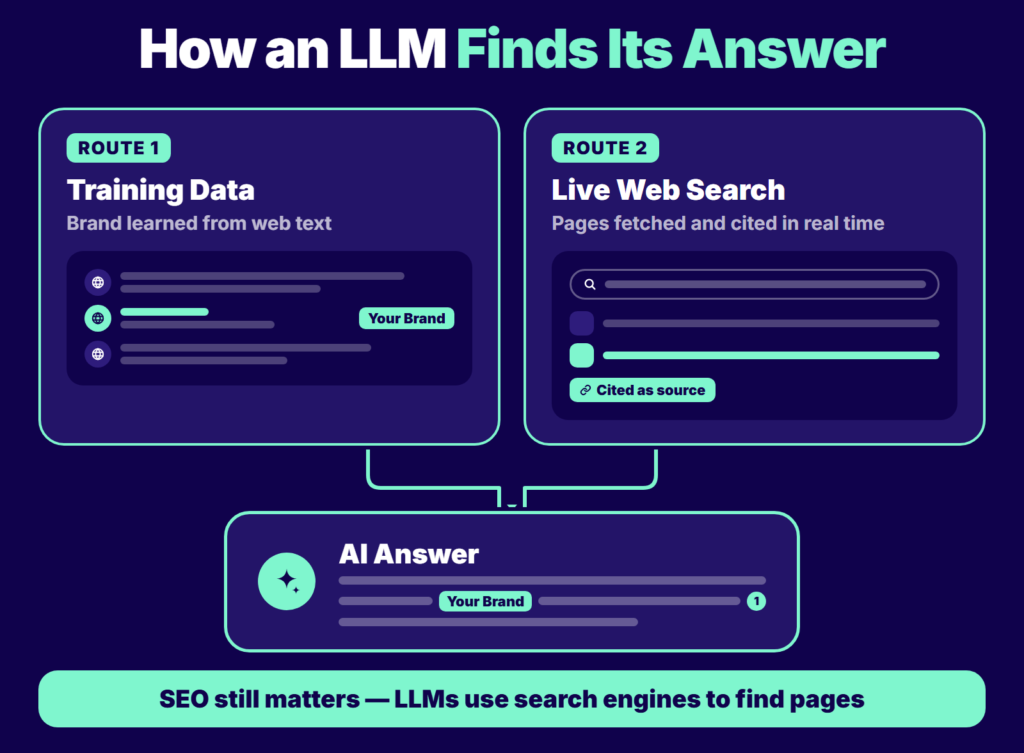
LLMs tend to get their information in 2 main ways:
From Their Training Data: Before an LLM model is launched, it learns from a massive amount of data from across the web. And if your brand appears in that text, the model is more likely to “Know” about you.
From Live Web Searches: Many tools now come with the live web search feature. Tools like Claude and ChatGPT can search the web in real time and cite the pages they use for the response. Your website can then show up in those responses as a clickable link.
That explains why SEO still matters so much. LLMs use search engines, which means a piece of content that ranks well in web search is also likely to surface in AI answers. The main difference is that search engines find and rank web pages while LLMs use those pages to craft a direct answer to the query.
How Do You Optimise Your Content for LLMs?
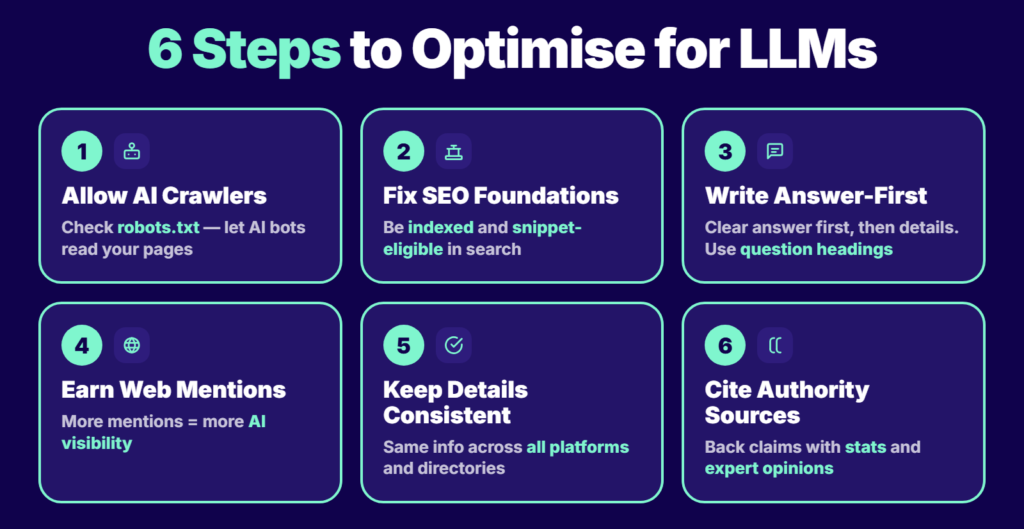
Here are 6 practical steps you can use to rank in LLMs:
Allow AI Crawlers to Access Your Website: If AI bots can’t read your pages, they can’t cite you. According to OpenAI, sites that block OAI-SearchBot won’t show up in ChatGPT search answers. Therefore, check your robots.txt file and make sure it’s letting AI crawl your pages. You can still block GPTBot if you don’t want models to use your content for training. These are two separate bots.
Get Your SEO Foundations Right: For Google’s AI features, your page needs to be indexed and eligible to show a snippet in search results. You don’t need to do anything. We cover this in more detail in our guide on how to get cited in Google AI Overviews.
Write Answer-First Content: Write a clear and direct answer for every main section. Add details afterwards. Try to use question-style headings; mimic how people talk to AI tools.
Earn Mentions Across the Web: A website with proper SEO foundations is a must. But you should not stop there. It’s only part of the larger picture. Ahrefs found that more web mentions correlate with more visibility across ChatGPT, AI Mode, and AI Overviews.
Keep Your Business Details Consistent: Use the same details on your website, social profiles, directories, and review sites. Consistent information makes it easier for AI engines to describe your brand and services accurately.
Cite Authority Sources: Back up your claims with statistics, authoritative sources, and expert opinions. This tends to build your content’s credibility. Content without expert sources gives AI tools little reason to pick you.
Do You Need an llms.txt File?
It can help. But you might not need it, at least for Google. An llms.txt file is simply a text file that supposedly helps AI tools read your site.
Google says you don’t need such files to appear in its AI features. An llms.txt file won’t hurt; it might help. But if you’re short on time, it’s not something to worry about.
How Can You Measure Your LLM Visibility?
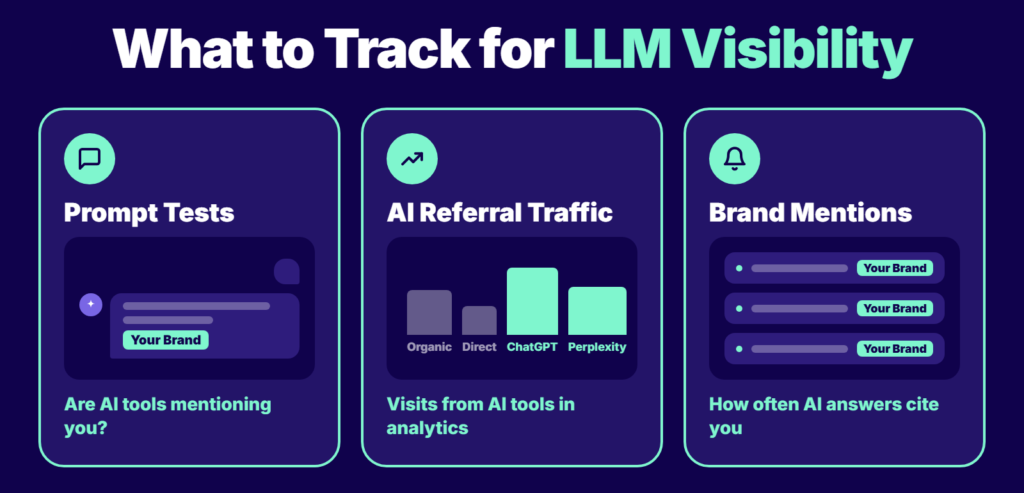
Visibility in large language models doesn’t work like a keyword ranking; you need to track some additional KPIs.
Test Your Key Prompts: Open LLM tools and ask them the questions your customers are asking. This is where traditional keyword research with tools like Ubersuggest can help. Observe the responses; is AI mentioning you? How is it describing you? If you’re not coming up, which competitors do? AI answers can change depending on several factors, so it’s a good idea to repeat this manual test once in a while.
Track AI Referral Traffic: Keep track of your analytics for visits from AI tools like ChatGPT and Perplexity.
Watch Out for Your Brand Mentions: Some tools like Ahrefs Brand Radar and Semrush’s AI toolkit can show how often AI answers mention your brand.
How Can AI SEO Help With LLM Optimisation?
For LLM optimisation to work, your technical SEO foundation and content need to move in the right direction. AI SEO helps businesses with all the important parts of that, from technical foundation to GEO, AEO, and AI visibility tracking.